
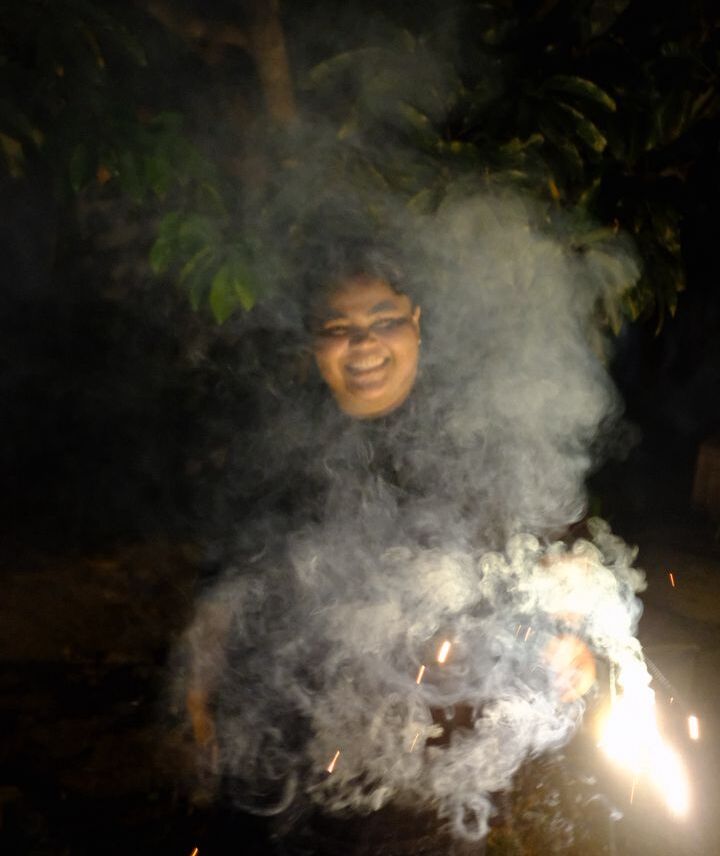
This is a story about Shaz. Three years without work. An only child. An illness that draws the curtains. This story is about someone who comes back, month by month, art table by art table.
After joining an art therapy session by myWIPhealing for the first time, she walked again into myWIPhealing’s event at Muzium Telekom in 2022. She came as a volunteer, there to help the day run. A person who arrives to give before they know they are also here to courageously receive.
Shaz has MDD. Major Depressive Disorder. She is an only child. No siblings to call, no shared childhood, no one who grew up in the same house. Despite being a person who has already been practicing solitude her whole life, Shaz chose to get involved.
The event was at Muzium Telekom. Shaz had heard about it through Khairini, the founder; and showed up as a volunteer. She walked through the door thinking: I can be useful here. She helped set up and run the event. The art therapy happened alongside the volunteering. The community happened alongside the art. And between the beginning and the end of it, Shaz found a reason to keep coming back.
There is a word in Malay, serabut, that describes the mind when it refuses to calm down. It’s not anxiety exactly. It’s not panic either. Serabut is when your thoughts do not stack up, when the sensation of your inner world becomes so cramped it’s like there’s no way out. This word has no English equivalent because perhaps English, with its preference for clean clinical terms, was never built to hold it. Of all the art therapy sessions she attended over three years, one form stayed. Scribble. There were many art therapy sessions: painting, zine-making, collage, but scribble art stuck in her head the most. It is the closest visual language to serabut itself. She laughs slightly when she describes it: “bentuk dia macam cacing ke apa semua kan”. The shapes look like worms or whatever. They look like what the inside of a tangled mind might look like if you put a pen in its hand and let it run. A mess of lines on paper that looks like nothing and means everything to her.
With scribble, there is no wrong shape. You cannot fail at being serabut on paper. The mess is the standard method. And for Shaz, putting the tangle outside herself — externalising the knot, giving it a form, watching it become something she could look at rather than something she was trapped inside — made it, fractionally.. more bearable.
Over the years, Shaz tried nearly every art therapy format SHIPS offered and she loved the variety of it, the fact that each month brought something different. Collage. Painting. Mixed media. She showed up for almost all of them, driven partly by curiosity and partly by the thing she values most in the world and has had to work the hardest to find: other people. “Aku suka bersosial walaupun dalam keadaan kekangan kesihatan aku,” she says. I like socialising, even within the limitations of my health. MDD is precisely the illness that makes socialising feel impossible — that severs you from the desire to reach out, that drains the ordinary pleasure of another person’s presence. To socialise through it, despite it, alongside it, requires not willpower exactly but a kind of stubborn love for the warmth of other humans that the illness cannot quite extinguish.
Shaz has that. She was born with it.
In 2022, before she walked into that first myWIPhealing event, Shaz had not worked for three years. Three years is long enough to forget what it felt like to have somewhere to be in the morning. Long enough to lose the small daily certainties — a commute, a task, a colleague who says good morning — that most people take for granted and that turn out to be, when they are gone, a significant part of what keeps a person tethered to the world. Three years is long enough to begin to doubt whether you were ever the kind of person who could work at all. The old version of yourself — functional, present, useful, were those real? Or only a story you told yourself? MDD does that. Some people see it as laziness or a lack of discipline or ambition. Yet, it is an illness that attacks the capacity to show up to other people, to obligations, to yourself. And the longer you are away from ordinary life, the more ordinary life begins to feel like somewhere you no longer have the right to return to.
But Shaz came back. Slowly. Through art tables and volunteer shifts and monthly sessions where she sat with people and made art things. “Aku dapat naikkan confident aku untuk berhadapan dengan orang,” she says. I was able to build up my confidence to face people again. And then: “Dan aku boleh kerja semula masa tu.” And I was able to go back to work. She says it in a single breath, having perhaps not yet fully measured its weight. Confidence is not a switch, it is a practice, specifically the kind of confidence you lose slowly over years of illness, and have to rebuild just as slowly. And what SHIPS gave Shaz was not motivation or insight or even community in the abstract. It gave her repetition. The same door. The same circle. Different media, same people. Month after month, the quiet evidence that she could show up. And one day she showed up somewhere else too — at a job, in the ordinary world, among people who had no idea what it had cost her to be there.
When the Writer asked her what she’s hoping for herself, she devastatingly said, “Aku cuma minta aku diberikan kekuatan. Kesihatan untuk aku kerja, untuk aku boleh kumpul sedikit duit supaya di masa tua nanti aku tak membebani hidup orang lain.” I only ask to be given strength. Health to work, to save a little money, so that when I am old I will not be a burden to anyone else. There is a whole history in that wish. The history of someone who has needed help, and felt fear that needing help makes you someone who imposes, who takes without giving back, who is too much. It is the fear of many people who live with chronic illness. She has learned, somewhere, that her presence requires justification. That to be in the circle she must also be useful to the circle.
But SHIPS teaches otherwise. You do not earn your place in a circle. You occupy it. Your presence does not require proof of productivity. The circle holds you whether you are giving or receiving, whether you are well enough to help or only well enough to be present. The scribbles you made that looked like worms were enough. You were enough. You were enough before you went back to work, and you were enough in the three years you couldn’t. That is what a circle means.
Ask Shaz why she keeps coming, and she will not talk about her own recovery first. She will talk about watching other people arrive happy, leave happy, meet each other for the first time and light up. “Aku suka tengok orang happy.” I like seeing people happy. She says this several times, in different ways, describing accurately what sustains her — the pleasure of watching another person arrive carrying something and leave a little lighter, a genuine source of nourishment. Of being in the room when that happens. Of knowing she is part of what made it possible. She has been the only child in many rooms over many years, watching groups cohere around their shared history, their sibling language, their easy references to a childhood she didn’t have. SHIPS answers her need: a circle where you belong because you arrived, not because you were born into it. Shaz has discovered what many people in peer support eventually discover: that giving and receiving are not opposites. Watching the community flourish feeds something in her too. This is what social healing looks like when it is working.
For the generations coming after her, she has one wish — simple, urgent, and exactly the kind of wish that only someone who has carried stigma knows how to make: “Semoga generasi yang akan datang lebih celik tentang kesihatan mental. Segala stigma tu berkurang.” May the generations to come be more aware about mental health. May the stigma lessen. She does not add: so that people like me don’t have to carry this alone. She doesn’t need to. It is already there, between the words, in the shape of everything she said. And then she says what she hopes for the MyWIPhealing team. “Aku harap dapat tengok kita punya team semua maju jaya.” I want to see our team all succeed and flourish. Not their team. Our team. In 2022, she came to help someone else’s event. Somewhere in the years since, it became hers too. She doesn’t describe herself as a member of SHIPS. She doesn’t say I joined or I attend or even I support. She says kita punya team, and kita in Malay is not their. It is not even your. It is ours.
Shaz may not be a founder of myWIPhealing but she was there before the name SHIPS existed. She swept a floor at Muzium Telekom and sat at an art table and made worm-shapes on paper, and then she came back the next month, and the month after that, and three years later she calls it our team. Somewhere in that slow alchemy, she stopped being someone who helps us and became someone without whom we would simply be less.
She is not adjacent to SHIPS. She is among us. She is part of what makes us what we are. She was here before we knew what to call ourselves, and she will be here long after whatever name we give this thing next.
Shaz has been part of myWIPhealing since the very first event in 2022. She is a founding community member, a volunteer, and one of the people who helped build what SHIPS became. She shared her story over WhatsApp voice note, plainly and without asking for anything in return. Her name is used here with her full permission and our deepest gratitude.
If something in this essay found you, the door is open.
It has always been open.
A note from the Writer: I did not include the transcript’s exact phrasing of her diagnosis’s clinical history because she did not offer those details. She offered a word, MDD, and moved on. To dwell on it would have been to place her illness above her personhood, which is precisely the thing stigma does and we must resist. Shaz’s story doesn’t have a resolution, because her story is still being courageously lived.